
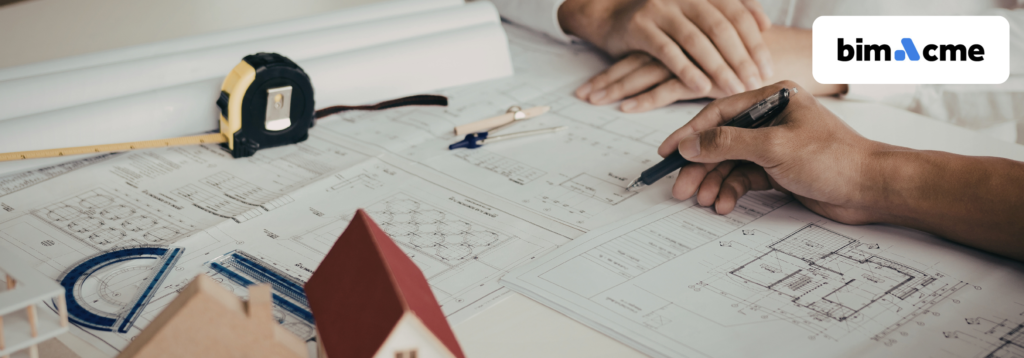
In India, you must obtain a building approval before beginning any construction project. You must also submit detailed documentation to local municipal development authorities and planning bodies to prove your proposed project complies with regional and national regulations. That is exactly where Construction Drawings come into play.
Construction Drawings provide a technical representation of the building design, enabling authorities to verify whether the project complies with the applicable standards. A project is likely to be rejected in the absence of Construction Drawings.
However, Construction Drawings are just as complex as crucial. Hence, you need professional support to increase your chances of obtaining building regulation approvals. If you have got an upcoming project, here is what you must know about Construction Drawings and their role in building regulation approvals.
Adhering to the National Building Code (NBC)
The NBC is the rulebook of construction. Authorities check whether your architectural or structural drawings comply with the national standards. Whether the thickness of the wall or the concrete grade, drawings prove the structural resilience of your building against cyclones or earthquakes – factors critical across various Indian seismic zones.
Calculating FAR and FSI Precisely
Floor Area Ratio (FAR) and Floor Space Index (FSI) are aspects that determine how much you can build on a particular land parcel. Construction Drawings, particularly site plans and floor plans, provide precision measurements that authorities need to calculate these ratios. If your drawings show a built-up area exceeding the permissible limit, your plan will be rejected. Precision and accurate Construction Drawings ensure your project stays within the legal boundaries of your property.
Complying with Local Development Control Regulations
Each city has its unique Development Control Regulations (DCR) or Unified Development Control and Promotion Regulations (UDCPR) that govern multiple aspects such as building height, setbacks, FSI, and land usage. Construction Drawings enable authorities to verify the requirements with the help of detailed site and building layouts.
Such insights allow planning officials to ensure your project aligns with city planning guidelines and that it does not violate the applicable zoning rules.
Supporting Fire Safety Approval
Complying with fire safety is crucial for various building types in India. These particularly include high-rise residential complexes, commercial buildings, hospitals, and educational institutions. This is where Building Regulation Drawings come into play. They include several details, including fire safety layouts that highlight emergency exits, refuge areas, fire escape staircases, and fire access routes. Additionally, the drawings can also have details such as the placement of fire hydrants, alarm systems, and sprinklers.
The fire department reviews these drawings to verify whether the building complies with fire protection requirements and enables safe evacuation during emergencies.
Verifying Accessibility and Public Safety Standards
Indian building regulations are not anchored to structural strength, resilience, and plans. They also emphasize accessibility and universal design. Public building structures must accommodate elderly, people with disabilities, and individuals with limited mobility.
Building Regulation Drawings demonstrate features such as lifts, ramps, accessible restrooms, and correct corridor widths. This help verify if a building design adheres to inclusivity guidelines and enables safe movements within the building.
Detailing Building Services and Utilities
Construction Drawings also comprise detailed layouts of MEP (mechanical, electrical, and plumbing) systems. While electrical systems show lighting arrangements, wiring layouts, and power distribution systems, mechanical drawings demonstrate ventilation and HVAC systems. On the other hand, plumbing drawings illustrate drainage networks, water supply lines, and sanitation arrangements.
These drawings enable authorities to verify that essential building systems are designed safely and that they adhere to the applicable technical rules and regulations.
Supporting a Quicker and More Efficient Approval Process
Incomplete, inaccurate, or unclear drawings often result in revisions, queries, and, therefore, approval delays. Significant delays in plan approvals can also delay the construction process. These hold-ups can increase the overall project cost.
Professionally-prepared Construction Drawings ensure accuracy and compliance, thus expediting the building approval process. Authorities can review them more effortlessly, efficiently, and therefore, may have fewer queries.
Such efficiency of review benefits the project’s stakeholders, such as architects, developers, contractors, etc., by helping them maintain the project timelines with ease.
Have a Construction Project Next? Hire Professional Construction Drawings Support
With decades of combined experience in industrial, commercial, and residential projects, Bimacme specializes in Building Regulation Drawings, Construction Drawings, and Sketch Drawing Construction. We provide professional drawing support to ensure accuracy, precision, compliance, and a more seamless approval process.
So, if you have an upcoming construction project, you know why opt for professional support and who to partner with. Email us at info@bimacme.com to connect with our experts and enter a detailed dialogue to discuss your specific project requirements.