
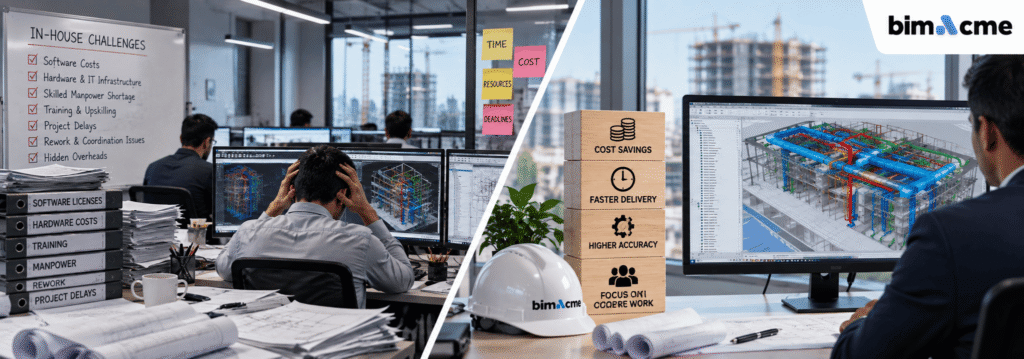
Many contractors build an in house MEP BIM team to keep control over quality and schedule. On paper, this choice looks simple and cost effective from the start. The real picture only appears once software, staffing, and training costs are added up. Contractors comparing options against MEP BIM Coordination Services often miss several expenses hiding in plain sight. Understanding the full cost helps teams make a decision based on facts, not assumptions. This blog breaks down the numbers most budgets leave out before the final call is made.
Why In House MEP BIM Looks Affordable at First
Most contractors only count the costs that show up on an invoice each month.
The Visible Costs Contractors Usually Track
Salaries, software licenses, and workstation hardware make up the obvious line items in any budget. These numbers are easy to compare and easy to justify to leadership during a budget review. They fit neatly into a spreadsheet, which makes the initial decision feel simple. They rarely tell the whole story about what an in-house team truly costs. Many contractors stop the calculation right here and move forward with confidence. Unfortunately, this early confidence often fades once the first busy season arrives on site.
The Hidden Costs Most Contractors Miss
Beyond salaries and software, several ongoing expenses quietly add up over time.
Software Licenses and Constant Upgrades
Revit, Navisworks, and related tools require yearly renewals that rarely stay flat year over year. Add ons, plugins, and cloud storage for large models increase this cost further. Hardware also needs regular upgrades to handle bigger and more detailed MEP models. Workstations built for heavy Revit files are not cheap, and they age faster than most teams expect.
Training Time and Staff Turnover
New BIM modelers need weeks of training before they match firm specific standards and workflows. Even experienced hires need time to learn a firm’s naming conventions and modeling habits. When a trained coordinator leaves, that knowledge and time investment leaves with them. Replacing skilled staff takes months in a competitive hiring market across the country. During that gap, projects either slow down or shift onto staff who are already fully booked.
How In House Coordination Affects Project Timelines
Cost is only part of the story, since timelines suffer in ways that are harder to measure.
Limited Bandwidth During Peak Season
An in-house team sized for average workload often struggles when several projects peak together. Overflow work gets delayed, rushed, or handled by staff already stretched across other tasks. Rushed coordination raises the odds of a clash slipping through before drawings go out for construction. This directly affects how quickly clashes get resolved before construction begins on site. Delayed clash resolution often pushes problems into the field, where fixes cost far more time and money.
Slower Clash Resolution Without Dedicated Focus
In house teams often split time between modeling, coordination, and unrelated documentation tasks. This split focus slows down clash detection compared to a team dedicated only to coordination. Dedicated MEP BIM Coordination Services teams focus solely on resolving conflicts before they reach the field. That focus alone often shortens coordination cycles by several weeks on a typical project.
Comparing In House Costs to Outsourced BIM Coordination Services
Once hidden costs are added up, the comparison against outsourced support looks very different.
Fixed Costs vs Scalable Support
An in house team carries fixed costs whether workload is high or completely quiet for months. Idle capacity during slow periods is a cost that rarely shows up in any report. Outsourced BIM Coordination Services scale up or down based on actual project demand each month. This flexibility often saves money across a full year of mixed project volume. Contractors pay for coordination only when they actually need it, rather than year round overhead.
Why Bimacme Solves This Cost Gap for Contractors
A partner built around flexibility removes many of the hidden costs contractors face in house.
Bimacme’s Flexible Staff Augmentation and Coordination Support
Bimacme gives US contractors access to skilled Revit MEP modelers without long hiring cycles or fixed overhead. Teams scale up during busy seasons and scale down when workload slows naturally. This model delivers the accuracy of MEP BIM Coordination Services without the hidden costs of an in house build out. Contractors keep full visibility into the model while avoiding the burden of hiring, training, and retaining staff.
Keeping MEP BIM in house is not wrong, but the full cost is rarely calculated upfront. Software renewals, training time, staff turnover, and idle capacity all add real expense over time. Comparing these numbers against outsourced BIM Coordination Services gives contractors a clearer picture. That clarity leads to better decisions about budget, schedule, and long term project quality. Contractors who run this comparison early tend to avoid costly surprises later in the build.
Bimacme helps US contractors calculate the true cost of their MEP BIM approach with no pressure. Contact Bimacme today to explore flexible coordination support built around your actual project needs. Contact us now at info@bimacme.com