
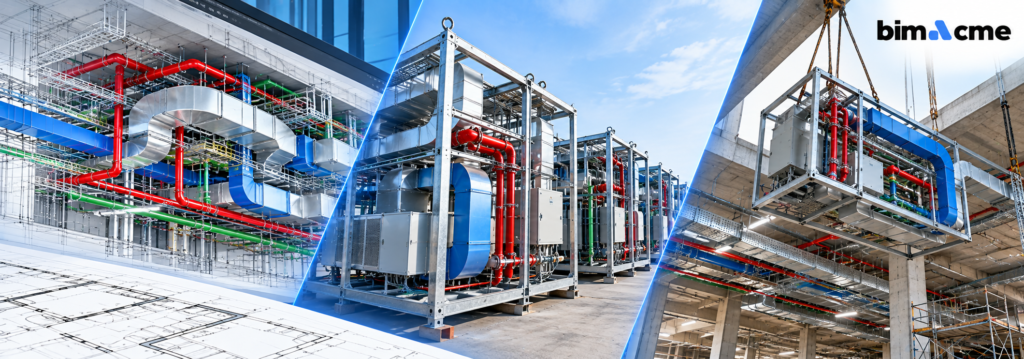
Installation schedules slip when crews wait on parts, fix conflicts, or measure on site. Prefabrication moves much of that work into a controlled shop setting. It only works when the model underneath is accurate. US mechanical contractors now rely on BIM to make that happen. Rising labor demands and tight deadlines make this approach more valuable every year.
This article explains how fabrication level models shorten installation time. It also covers the drawings that connect the model to the shop floor. Our team at Bimacme delivers MEP Prefabrication Modeling for ducts, pipes, and multi-trade racks. We also provide MEP Shop Drawings Services that crews can build from directly.
Why Prefabrication Saves Installation Time
Prefabrication changes where and when the work gets done.
Work moves from the site to the shop
Assemblies get built indoors, away from weather and crowded floors. Crews work at a steady pace with the right tools. Finished pieces arrive ready to hang. Quality improves because cuts and joints are made in controlled conditions.
Tasks run in parallel
While the shop builds assemblies, site crews prepare supports and openings. Both efforts happen at the same time. That overlap is where weeks come back into the schedule. Shop output stays steady even when site access is limited.
What MEP Prefabrication Modeling Involves
Prefabrication needs a model built for fabrication, not only for coordination.
Fabrication level detail
Models include exact lengths, fittings, flanges, hangers, and insulation. Weld and joint locations are marked clearly for the shop. Hanger types and insulation thickness are set at this stage. Elements are broken into pieces that fit shipping and lifting limits. Our MEP Prefabrication Modeling follows the fabrication standards your shop uses.
Spool and rack modeling
Pipe is divided into spools with clear joints. Spool numbers tie each piece back to the model. Multi-trade racks combine duct, pipe, and conduit on shared supports. Each rack is checked against structure and ceiling space before release. Racks also reduce the number of lifts needed on site.
Coordinated with every trade
Fabrication only starts after clashes are resolved. Sleeves, penetrations, and hanger points are confirmed first. This stops rework before parts leave the shop. Every trade signs off on the final layout.
The Role of MEP Shop Drawings Services
Shop drawings carry the information in the model to the people who build.
From model to shop floor
Drawings show dimensions, part numbers, and assembly details. Bills of material list every part of each assembly. Fabricators read them without needing to open the model. Our MEP Shop Drawings Services produce sheets matched to your shop and your field crews. Each drawing is checked against the latest model before release.
Installation drawings for the field
Field crews get layout sheets with hanger locations, elevations, and install sequence. Good drawings reduce questions and field measuring. Crews spend more time installing and less time interpreting. Revision clouds show what changed since the last issue.
Where US Mechanical Contractors See the Biggest Gains
Time savings show up in a few specific parts of the schedule.
Less field measuring and fitting
Accurate models give shops reliable dimensions. Parts fit when they arrive. Cutting and adjusting on site drops.
Fewer delays between trades
Coordinated models let trades install in a planned order. Crews know what goes in next. Racks and mains go up first. Smaller runs follow without conflicts. Clear drawings also make inspections smoother.
Better material control
Itemized models produce clean material lists. Purchasing and delivery match the install sequence. Less material sits around on site. Waste drops because parts are cut to model lengths.
Planning a Prefabrication Workflow
A clear plan keeps the shop and the site working in step.
Set the level of detail early
Agree on the level of detail before modeling begins. Fabrication models need more data than coordination models. Early agreement avoids rework later.
Plan for shipping and handling
Assemblies must fit trucks, doors, and hoists. Weight limits matter as well. Models should break pieces into sizes that move safely.
Align the model with the schedule
Release assemblies in the order crews will install them. This keeps deliveries on time. Storage space on site stays under control.
Safer and cleaner sites
Less cutting, welding, and overhead work happens on the floor. Sites stay cleaner and safer for every trade.
Why Work With Bimacme
Bimacme supports mechanical contractors with fabrication ready deliverables.
Modeling built around your shop
We ask about your fabrication methods early. Our models and drawings then follow your part libraries and standards. That keeps the handoff to your shop smooth. We can start from your design model or from drawings you already have.
Standards for US projects
We work in US units and conventions. Our team coordinates with your project engineers and detailers. Deliverables arrive in the formats your workflow needs. Our team uses your naming rules so parts are easy to track.
Conclusion
Prefabrication cuts installation time when the model is built for it. Accurate detail, resolved clashes, and clear drawings let shops build with confidence. Crews then install faster and with fewer surprises. Contractors who plan this way recover real time in the schedule. Bimacme helps teams get there with clear models and drawings.
Talk to Our Team
Want to bring prefabrication into your next project? Contact Bimacme for a free scope review. Share your plans and schedule, and we will recommend a clear approach.