
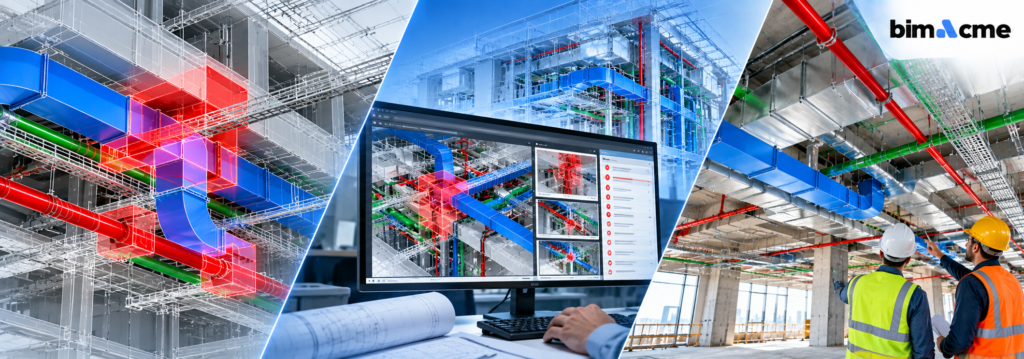
Many teams still treat clash detection as a single checkpoint. They run one report, fix what it finds, and move on. Buildings do not stay still that long. Designs change, trades add detail, and field conditions shift. Conflicts appear again unless checks continue. Clash detection works best when repeated at planned intervals.
US general contractors now build coordination into every phase of the project. This article shows how that works and why it pays off. Our team at Bimacme provides MEP Clash Detection Services that run alongside design, preconstruction, and construction. They sit within our wider Construction BIM Services.
Why One Clash Report Is Not Enough
A single check shows the model at one moment in time.
Models change every week
Designers issue revisions. Subcontractors add hangers, supports, and equipment. Each change can create new conflicts in areas that were clear last week. Coordination reports must keep pace. Fast reviews keep trades from building on outdated information.
Late clashes cost the most
A conflict found in the model is a quick fix. The same conflict found in the field means demolition, reorder, and lost time. Lost time often affects other trades as well. Regular checks catch problems while they are cheap to solve.
Clash Detection Across Each Project Phase
Each phase has its own goals for coordination.
Design and preconstruction
Early checks compare architecture, structure, and MEP. Teams settle major routing before detail work grows. Structural and architectural changes are common here. Our MEP Clash Detection Services support this stage with clear, prioritized reports.
Fabrication and procurement
Before parts are released, models need a final clean check. Fabrication level detail exposes conflicts that coarse models hide. Fixes at this point save material and shop hours. Suppliers then receive parts that fit.
Installation and field verification
Models are updated as work goes in. Field changes and approved substitutions are captured. This keeps the model reliable for the remaining trades. Field teams report deviations so the model stays current.
Closeout and handover
A final model records what was built. Owners receive data for maintenance and future renovations. Our Construction BIM Services include as-built updates for this purpose. This record also helps with warranty work.
Tools and Deliverables That Support Clash Detection
The right tools make repeated checks fast and consistent.
Federated models
Each trade model is combined into one federated model for review. Software such as Navisworks runs rule based tests across all trades. Teams then filter results by area and system. Clean naming helps the software sort results quickly.
Clear reports and viewpoints
Each issue includes a saved view, a location, and a short note. Trades can find the conflict in seconds. Priorities show what to fix first.
Links to RFIs and field issues
Model issues connect to RFIs and field reports. This gives everyone one source of truth for open items.
Types of Clashes Teams Need to Track
Not every conflict looks the same, so reviews should cover several types.
Hard clashes
These are physical overlaps, such as a duct passing through a beam. They are the easiest to detect because software finds them automatically. They still need clear ownership for resolution.
Soft and clearance clashes
Soft clashes break required clearances for access, insulation, or code. Maintenance space is a common case. These conflicts often surface only after install when nobody checks.
Sequence and schedule conflicts
Some conflicts relate to installation order. Large equipment often needs to enter before a wall closes. Linking the model to the schedule helps teams plan these moves.
Making Ongoing Clash Detection Work
A repeating process needs structure to stay useful.
Set clear rules early
Agree on tolerances, model standards, and software before work starts. Name who owns each trade resolution. Consistent rules make reports easy to act on. Shared naming and coordinate systems prevent confusion.
Hold regular coordination meetings
Weekly sessions keep issues moving. Meetings stay short when reports are prepared in advance. Teams review open items, assign owners, and set due dates. Reports should stay short and focus on what is still unresolved. Decisions are logged so nothing is lost between sessions.
Track issues to closure
Every conflict needs a status. Open, assigned, and closed items give managers a clear view. This record also supports RFIs and change management. Aging reports show which conflicts need escalation.
Why Work With Bimacme
Bimacme gives general contractors a steady coordination partner across phases.
Continuity from start to finish
One team can follow the model from early design through closeout. That continuity means fewer handoffs and less lost context. Clients get one point of contact for model updates. Our team supports this approach on every project.
Reports your team can use
We prepare clear clash reports with images, locations, and priorities. Superintendents and project managers can act on them quickly. Our reports use plain language, not software jargon. Our work follows US project conventions. We also join coordination calls when needed.
Conclusion
Clash detection works best as a habit, not a milestone. Models change, so checks must continue through every phase. Regular reviews protect the schedule, the budget, and the quality of the install. General contractors who adopt this approach face fewer surprises in the field. Bimacme helps teams keep that rhythm from start to finish.
Talk to Our Team
Ready to build coordination into every phase? Contact Bimacme for a free scope review. Share your project details, and we will outline a clear plan.